

John Hull, EGM CEO
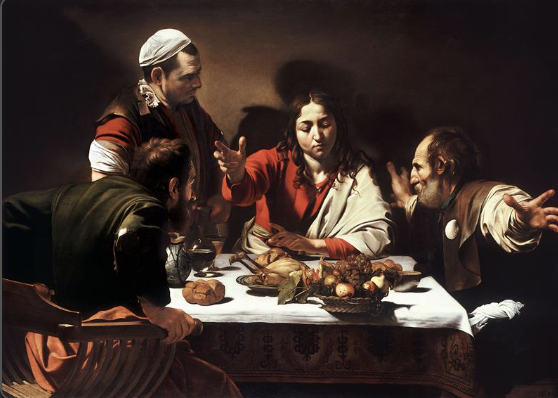
Visio Divina | Luke 24:13–35
Click here to read the scripture text: Luke 24:13–35
Two travelers spend an entire day walking beside a stranger and never once recognize him. Luke says their eyes were kept from seeing. It is only at supper, when the guest they had invited in takes the bread, blesses it, and breaks it, that they finally know him — and in that instant he vanishes. Caravaggio paints the half-second of recognition: one disciple gripping the arms of his chair as if to launch out of it, another throwing his arms wide, an innkeeper standing close by who sees nothing but a meal. The man they welcomed as a guest has become the host. The bread they meant to set before him is the bread he is now giving them.
When I first became the director of our Men's shelter, I had already been at the mission several years. At the time I worshiped in a tradition that prayed the Lord’s Prayer aloud every Sunday. Give us this day our daily bread. I had said the words so many times they had gone smooth — worn like a stone in a river, familiar and easy to hold. I do not mean I prayed them without feeling. I mean I had stopped examining what they actually claimed. The words had become a kind of truth I recited without ever testing it against my life — smooth enough to pass through me without ever catching.
Then one afternoon I was standing in the day room watching the line form for the coming meal. It came to me slowly that some of the men in that line wondered, “when it’s my turn to get some food, will there be any left for me?” As a first time guest, they had no way of knowing yet that our kitchen is run so that we never run out — that here, for once, there would be enough. They were carrying the uncertainty in with them, learned in all the places that had already let them down. Some of them, the day before, had found their food however they could — behind a restaurant, in a dumpster, in ways I would rather not picture. The prayer I had worn smooth was the prayer they were living. They did not recite “give us this day our daily bread."
They prayed it with their feet, with their hunger, with their trust that today something would come.
What struck me was not their need. It was mine. I had never once had to pray that prayer and mean it literally. My security did not rest on God; it rested on my bank account, on my work, on an employer who would pay me what I had “earned.” My worry was never whether I would eat tonight — it was whether I had set enough aside for next month, and the month after that. I had built a life so cushioned that, from my perspective, the God I asked for daily bread had never actually had to provide any.
I want to be careful here, because there is a cheap version of what I felt, and I do not want to indulge it. I did not walk away romanticizing their hunger or wishing myself into their poverty. There is nothing holy about not knowing where your next meal will come from; I would not wish it on anyone, and to envy it would insult the very men who were teaching me. What I longed for was not their deprivation but their dependence — to learn, without having to be destitute to learn it, what it means to actually trust God for what a single day requires. They had something with God I had spent my whole life insulated from ever needing.
I came to serve them bread. They handed me back a faith I did not have.
This is the reversal we keep living. We arrive as the ones with something to give — a meal, a bed, a program, a plan — and if we are paying attention, we find that the people we came to serve are handing us things we did not know we were missing: patience, endurance, a faith worn into them by a hard road. Hospitality that flows only one direction is not really hospitality; it is charity with a hierarchy built into it. So I try to come to each person ready to receive and not only to give — to ask “What’s happening?” in a way that leaves room for someone to be my teacher and not only my project.
The God we serve is not poor. His life overflows, and some of the ways he pours it out reach us through the hands of the people we assumed we were rescuing.
Do we have eyes to see it?
This week, let someone you serve give you something — a thanks, a story, a kindness, a lesson — and receive it without deflecting or hurrying back to the giving role. If the moment allows, ask one person: “What is one thing you’d want me to understand about your life?” — and simply listen.
All EGM Team
For estate, planned (tax mitigation) and legacy giving, vehicle donations, and corporate partnerships, contact:
We’re grateful to receive donations of food, clothing, and toiletries alongside financial support. Every item below helps us serve up to 300 people each night across snohomish county.
Click here to view the list of items needed most.
It’s easy to do good when you use our Amazon wishlists to help us get our most current needs. You select what you want to purchase from our list, pay for it through amazon and ship it right to our door.
Help us be ready for the men, women, and children at the Mission and in the community who come here every day for desperately needed help.
We are grateful to receive donations of food, clothing, and toiletries alongside financial support.