
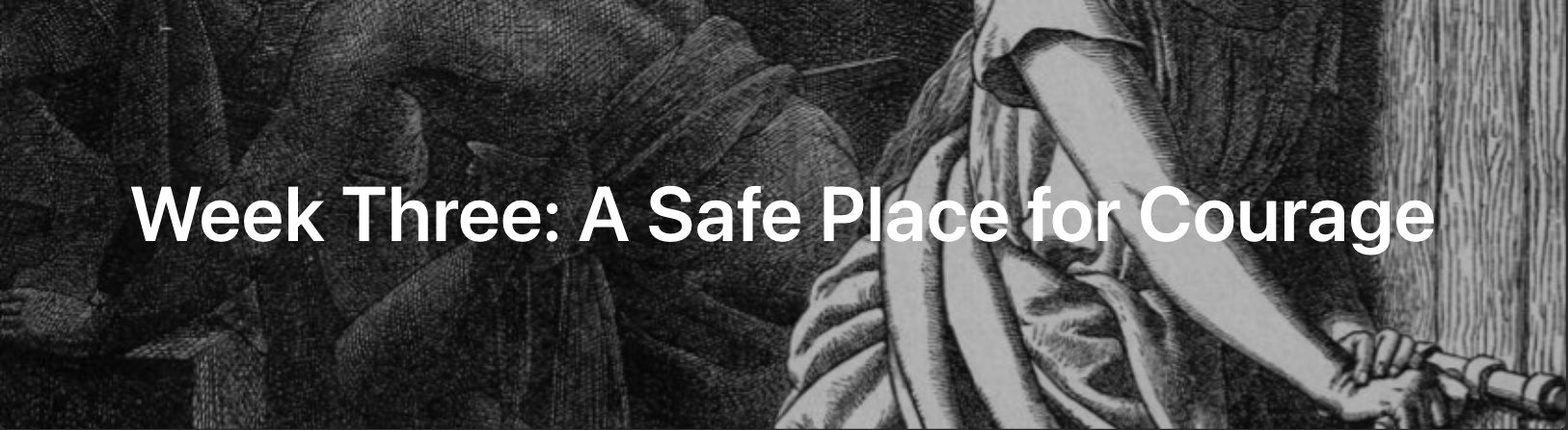
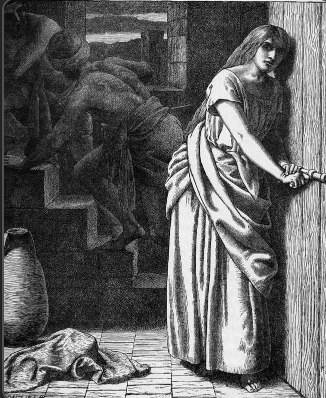
In the Pickersgill engraving of Rahab and the spies, the danger is not hidden — it is the whole atmosphere of the scene. Rahab is closing the king’s soldiers off who are on the other side of the door. She will soon cover them under the flax on her roof and then let them down out of the city. What the engraving captures is the moment before the rescue becomes possible: a woman the world had already written off, deciding to become a refuge anyway. Her courage does not come from certainty that the plan will work or that these men are safe to shelter. It comes from something she has heard about their God — a God, she says, who is God in heaven above and on the earth below.
She builds the safe place first, on the strength of what she believes about God, and only afterward does anyone’s safety follow.
After years of walking alongside people whose lives have been shaped by instability and harm, I’ve learned that courage rarely appears first. What appears first is caution. Watchfulness. A body that has learned not to hope too quickly.
Hospitality creates that protection. It offers a pause in the chaos. It says, you are not alone right now. For people whose lives have been shaped by instability, betrayal, or violence, this pause can feel unfamiliar — even unsettling. Yet it is precisely this steadiness that allows courage to emerge.
Rahab’s story reminds us that faith is not always loud. Sometimes it looks like keeping watch, holding space, and refusing to surrender someone to harm.
Hospitality becomes a form of resistance against despair.
At EGM, creating safety is not secondary work — it is sacred work. The people who reach us have lived for long stretches without reliable protection. They have learned to stay alert, guarded, and ready for disappointment.
Before growth can happen, the nervous system needs rest. Before trust can form, consistency must be experienced.
There is a courage this asks of us, too. Many of the people we welcome are among those our society fears most. We do not yet know them, and we have not had the time it takes to learn whether they can be trusted. So the courage to open the door cannot rest on our read of a stranger — it rests on something underneath that: a trust that God is already at work in the person walking toward us, that the same Spirit drawing us toward him has gone ahead of them through our gate. We are not asked to be naïve about the person. We are asked to be confident about God. That is what lets us make room before trust has had time to form.
This means we pay attention not only to rules, but to rhythms. We explain expectations clearly. We respond predictably. We keep our word. Over time, these practices communicate something deeper than policy ever could: you are safe here for now. In that safety, courage begins to return.
EGM Team make someone feel safe this week before you ask anything of them — a calm tone, a kept promise, an unhurried minute at the door. It might be a guest arriving at our shelter, a coworker, a child, a neighbor who long ago learned to brace for the worst. When you notice yourself holding warmth back until a person proves they’ve earned it, offer it first, and trust the good that God may already be doing in them.
For estate, planned (tax mitigation) and legacy giving, vehicle donations, and corporate partnerships, contact:
We’re grateful to receive donations of food, clothing, and toiletries alongside financial support. Every item below helps us serve up to 300 people each night across snohomish county.
Click here to view the list of items needed most.
It’s easy to do good when you use our Amazon wishlists to help us get our most current needs. You select what you want to purchase from our list, pay for it through amazon and ship it right to our door.
Help us be ready for the men, women, and children at the Mission and in the community who come here every day for desperately needed help.
We are grateful to receive donations of food, clothing, and toiletries alongside financial support.